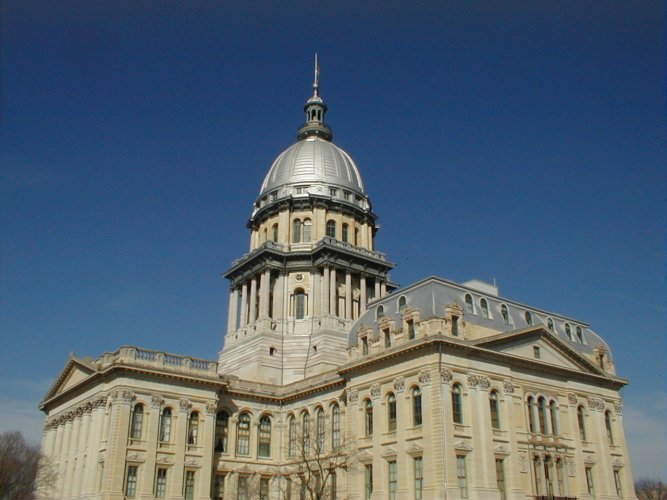
Illinois veto session is scheduled for six days in October, starting on Tuesday, October 14. This short fall session is named ‘veto session’ as it’s a chance for legislators to override any gubernatorial vetoes that took place over the summer after the spring legislative session. Despite the name, it’s also an opportunity for legislators to try to pass legislation that didn’t make it to the finish line in the spring. Two significant omnibus bills failed to pass in the final hours of spring session on May 31 – the energy omnibus known as the Clean & Reliable Grid Affordability Act (CRGA Act) and a transit reform and funding package. With veto session fast approaching, let’s dig into the energy omnibus and attempt to read the tea leaves as to whether it could pass.
What’s in the bill? EE Edition
The energy omnibus, which has a new bill number SB 25 HA002, went through seven amendments in the final days of spring session that changed the energy efficiency (EE) sections of the bill significantly.
Electric EE
Savings Goals: CRGA eliminates the cumulative persistent annual savings (CPAS) goals and sets a 2% annual savings goal for ComEd. The bill allows Ameren to ramp up savings over the next three years to reach 2% by 2029. A 2% annual savings goal would ensure Illinois remains an EE leader in the Midwest and nationally.
Peak Demand Savings Goal: Illinois investor-owned utilities (IOUs) do not currently have a peak demand savings goal. Throughout negotiations, a peak demand savings goal was included for both IOUs in some drafts of the bill but ultimately only Ameren’s remains in the current version.
Ability to Modify Goals: The current version of the bill allows both IOUs to negotiate lower savings goals in the 2026-29 plan cycle, meaning the actual savings achieved in the first plan cycle could be lower than the bill's stated savings goals for each utility.
Sources of Energy Savings: Under current law, electric IOUs are able to count a certain percentage of electric savings from gas therm savings achieved through joint programs with gas utilities. The allowable gas therm conversion rate is currently 10% of overall electric savings. In the latest draft of the omnibus, this jumps to 30% for ComEd and 20% for Ameren. Electric IOUs are also able to count savings from electrification equivalents. The utilities were able to claim up to 5% of overall electric savings from electrification in the 2022-25 plan and 10% in the 2026-29 plan. The current draft of the bill increases this to 20% meaning as much as half of ComEd’s and 40% of Ameren’s electric EE savings could come from sources other than traditional electric EE. When the bill was originally introduced, no more than 35% of electric savings could come from sources other than electric EE measures.
Budgets: The allowable electric EE budget for both IOUs remained the same throughout negotiations and stands at $562 million for ComEd and $231 million for Ameren. ComEd’s annual EE budget in the upcoming plan cycle is $454 million and Ameren’s is just over $126 million. Both utilities would also be required to spend a minimum of 25% of said budgets on income-qualified programs.
Performance Incentives: Under current law both ComEd and Ameren earn a baseline of 10.62% return on equity (ROE) for their EE programs. Utility ROE was a significant negotiation point throughout the spring. In the current bill ComEd’s ROE would be 8.91% while Ameren’s would be 8.72%. Additionally, each utility would be able to earn a performance incentive of up to 200 basis points (i.e. 2%) more in ROE for exceeding their savings goals. The maximum 200 basis points would come into effect for achieving 125% of their goal.
Industrial EE: Currently, large private energy customers can opt-out of paying into utility electric EE programs, meaning Illinois is currently losing out on significant and highly cost-effective energy savings from these mostly industrial users. Unfortunately, the current version of this bill would allow the status quo of the 10M+ user opt-out to continue.
Gas EE
Gas energy efficiency programs have not been substantially updated in Illinois since their inception in 2009. The original draft of the energy omnibus contained significant updates to gas EE including gradually increasing the annual savings goal to 1% of sales by 2029 with an average measure life of 12 years (similar to electric EE). It also shifted the focus of programs away from incentivizing gas end-use appliances by requiring 67% of gas EE budgets to go towards building envelope improvements. The gas EE provisions were completely removed from the energy omnibus over the course of spring legislative negotiations, and if the current version of bill passes it would be the third time an energy omnibus goes through in Illinois without updating gas energy efficiency.
EE Adjacent Areas in SB 25
Utility Data Access Act: A bill originally introduced as HB 3312 is contained in its entirety in SB 25. The bill would require investor-owned utilities to retain monthly billed energy consumption data for at least 15 years and provide the past two years of data to building owners at their request to assist owners with energy benchmarking.
Munis and Co-ops: SB 25 contains the Municipal and Cooperative Electric Utility Transparent Planning Act which would require municipal and cooperative utilities (“munis and co-ops”) to engage in integrated resource planning. The bill would not require munis and co-ops to participate in EE programs.
The 822-page omnibus impacts a great deal of other energy related areas including the creation of a battery storage procurement program, updates to Illinois’ clean energy procurement and transmission planning, among many other provisions.
Prospects for Passage
MEEA staff opinions on whether the energy omnibus will pass during veto range from deeply pessimistic to cautiously optimistic. It is a good sign that several subject matter hearings on the bill have been scheduled, the first of which took place virtually on September 18 in the Senate Energy and Public Utilities Committee. The House also held a subject matter hearing on September 25. The Senate has a second virtual subject matter hearing scheduled for October 2 at 10:30 a.m.. Various stakeholders would like to see further amendments to the bill, including amendments to the EE sections. While this is procedurally possible, it will be challenging to reopen negotiations around such a large bill, given the short timeline.
With only six legislative days in October, the energy omnibus’ potential may be impacted by the transit package, which is needed to avoid a major funding crisis for multiple transit agencies. While it looks like legislators are motivated to move an energy package forward, with such a short session and two omnibus bills under consideration, it’s entirely possible that the transit bill would take priority over energy.
Veto session will wrap up on October 30, and you can expect a thorough update in the October edition of MEEA’s Policy Insider. If you’re not subscribed to our member-only Policy Insider newsletter, please reach out to membership@mwalliance.org.