SPP’s New Resource Adequacy Rules in Action
SPP Resource Adequacy Rules Refresher
Back in July, MEEA reported on new Southwest Power Pool (SPP) Resource Adequacy rules. These new rules, approved in August 2024, established an Effective Load Carrying Capability (ELCC) for non-dispatchable resources and a Performance Based Accreditation (PBA) for dispatchable resources. SPP adopted an updated Accredited Capacity Planning Reserve Margin (ACAP PRM) for both summer and winter seasons. The ACAP PRM is calculated based on a utility’s peak load plus an assigned planning reserve margin percentage. For additional context on SPP’s new Resource Adequacy Rules, read MEEA’s first blog on the topic: A New Age of Resource Adequacy Part 1: An Introduction to SPP’s New Resource Adequacy Rules.
Overwhelmingly, the adoption of the ELCC and PBA derates, or reduces the accredited capacity of, a significant number of resources and has left generating utilities across SPP’s footprint scrambling to meet the new ACAP PRM. These new rules have a significant impact on some of the smaller utilities in SPP’s footprint – especially publicly owned utilities.
What’s Happening in Lincoln?
Nebraska is the only state in the country that relies exclusively on public power, taking the form of Public Power Districts, Municipal Electric Utilities and Rural Electric Cooperatives. Nebraska utilities are not incentivized to offer energy efficiency programs in the same way as many investor-owned utilities in states with mandated energy efficiency savings goals. Historically, Nebraska utilities invest about $8 million annually in energy efficiency. Lincoln Electric System (LES) is a municipal electric utility with approximately 150,000 electric meters in its service territory. In 2020, LES established a net zero goal by 2040, aiming to eliminate or offset carbon dioxide from their generation by 2040. This goal is challenged by SPP’s new resource adequacy requirements.
At the start of 2025, LES began a series of stakeholder engagement meetings and Administrative Board presentations, discussing the impact of the ELCC and PBA on LES’s existing accredited capacity (March 2025, May 2025). These rules dramatically impact LES’s winter accredited capacity, derating LES’s resources by 225 MW. Below you can see the implications of SPP’s new rules on LES’s load and capability over the next decade:
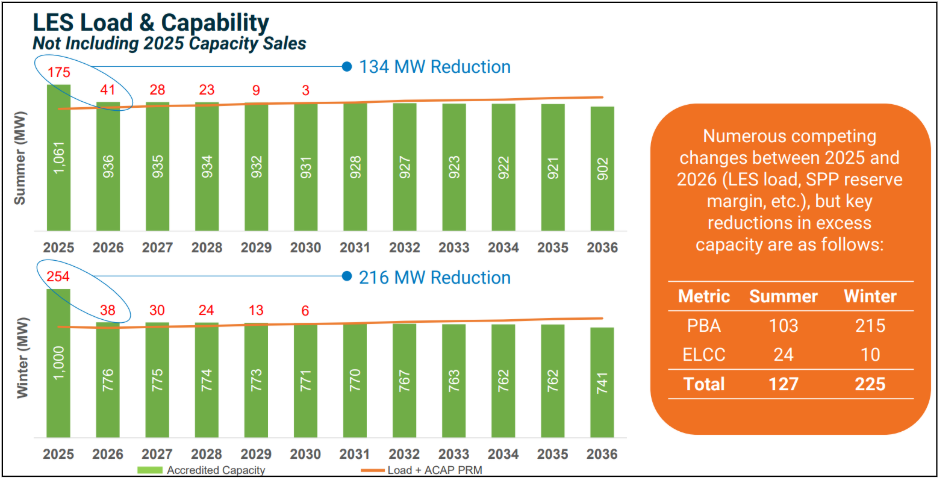
Source: Scott Benson. March 21, 2025. LES Resource Adequacy Position Presentation
In response to these rules, LES expedited the review of new resource investments and accompanying customer rate increases. In May, the LES Administrative Board approved the acquisition of two 50 MW natural gas aero combustion turbines (aero CTs), adding 100 MW of capacity (80 MW accredited capacity due to the SPP PBA) to the LES electric system. The initial cost of these CTs is estimated at $180 million and has resulted in an immediate rate increase of 4%, with larger increases looming. This investment only acts as a band-aid for rising demand and stringent regulations.
The addition of two aero CTs and a new hydroelectric project only pushes the utility’s “need year” to 2036. With supply chain delays extending gas generation project timelines to nearly 10 years in some cases, LES has proposed investment in another frame combined turbine (approximately $115 million for 80 MW of capacity) in the near term.
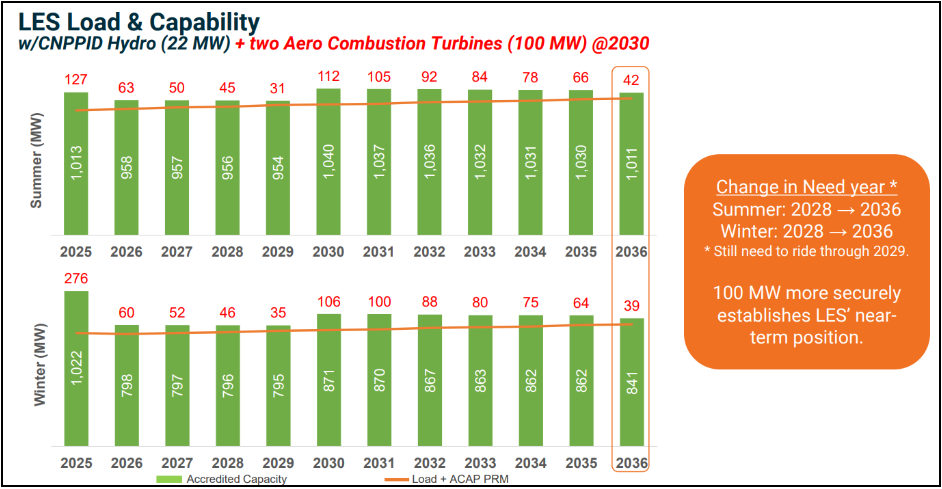
Source: Scott Benson. May 8, 2025. LES Resource Adequacy Generation Additions Presentation.
Throughout this process, LES modeled scenarios comparing investment in dispatchable resources, primarily natural gas, to non-dispatchable renewable resources, primarily wind, solar and battery storage. However, LES did not include any analysis of the opportunity for additional investment in demand side management (DSM) resources, such as energy efficiency and demand response, to help meet resource adequacy requirements at a lower cost.
Demand Side Management for Resource Adequacy
MEEA submitted comments to the LES Administrative Board analyzing the potential for increased energy efficiency and demand response spending to help meet resource adequacy requirements. As the ACAP PRM is calculated based on a utility’s peak load plus an assigned planning reserve margin percentage, a utility can lessen its resource adequacy requirements by reducing its peak load through DSM. Think of these interventions as “lowering the orange line” on LES’s Load & Capability graphs.
As SPP’s seasonal calculations have derated generation resources’ accredited capacity more in the winter than summer, SPP is now forced to plan resource investments primarily around their winter peak demand. This presents a challenge for demand-side management, as DSM resources have primarily provided solutions for summer peaks, with efficient cooling and demand response technologies. Winter peaks bring about different challenges due to the nature of winter peak events and the relatively low share of home heating technologies utilizing electric power.
There are a few key differences between winter and summer peaks – including their timing, duration and energy intensity. Winter peaks tend to occur twice a day, early in the morning (7 – 9a.m.) and after the workday, extending late into the evening, unlike summer peaks which tend towards one midafternoon energy spike. During extreme cold events, winter peaks can persist for longer, occasionally lasting more than 20 hours. Finally, heating for winter peaks tends to be more energy intensive than cooling for summer peaks. Say you are heating/cooling towards a 65 degree home – a very hot day (120 degrees F) produces a delta of 55 degrees, while a very cold day (-20) produces a delta of 85 degrees. Correcting for those deltas requires a different level of electricity.
Another factor in planning for winter peaks is that electric utilities often have far less control over heating energy use than cooling. Most homes use electricity to power air conditioning units; however, only a minority utilize electricity for home heating. While upgrading aged electric heating systems by swapping very inefficient electric resistance heating with advanced cold climate air source heat pumps (ccASHPs) can account for significant savings – extreme winter peaks challenge ccASHPs’ temperature limits. And while replacing gas heating with more efficient ccASHPs will reduce overall energy use in Btus, these new appliances will add to overall electric winter peaks.
At LES’s September Administrative Board meeting, the board approved LES Resolution 2025-8, which states that within one year of the resolution’s passage, LES must perform “energy efficiency and other demand-side management potential assessments” in conjunction with upcoming resource planning. This action opens a potential policy window to increase LES’s DSM investment and offset upcoming resource constraints.
In the final installment of this blog series, MEEA will explore specific DSM technologies and their ability to reduce a utility’s winter peak demand.